
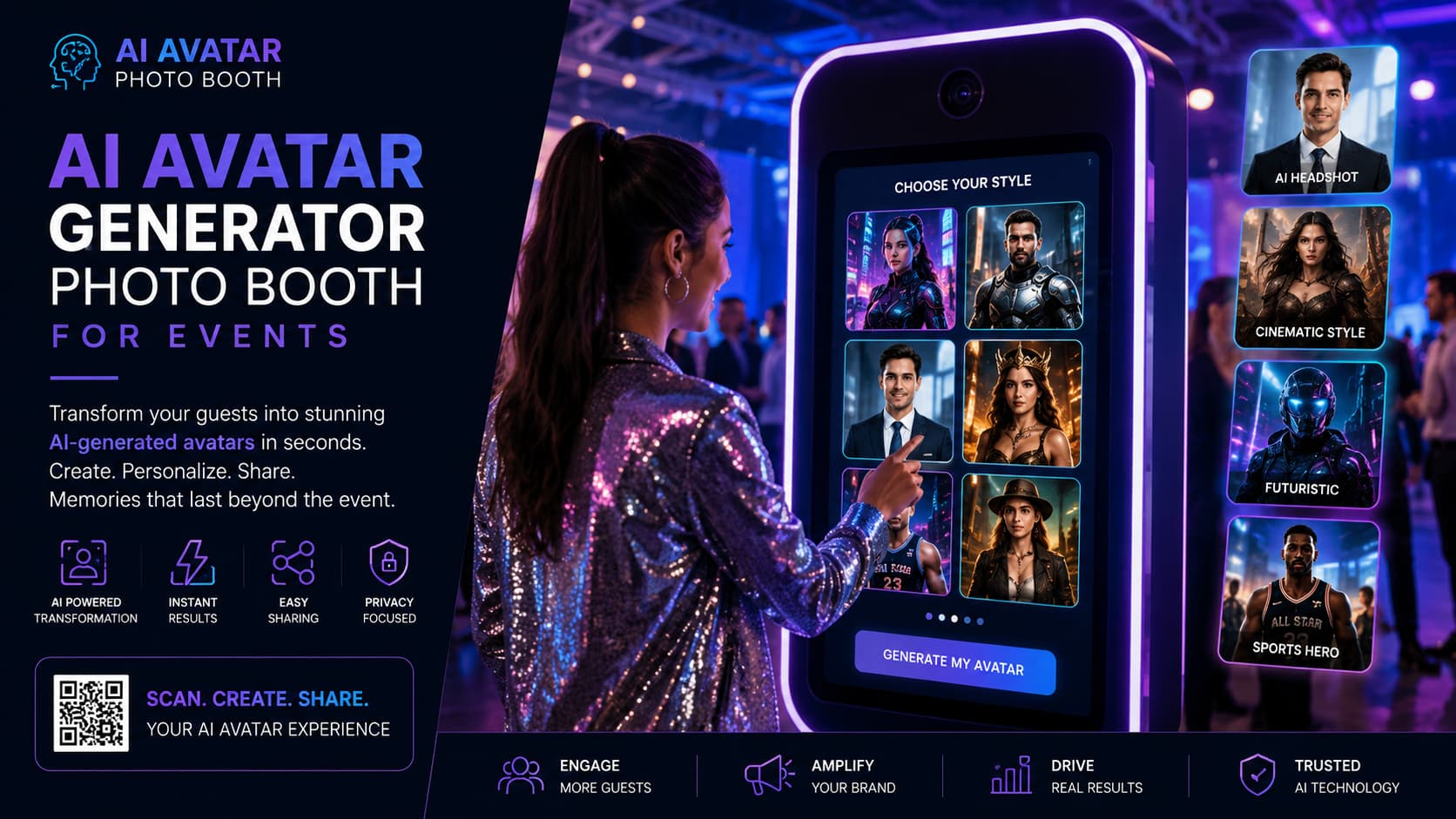
AI avatar generator photo booths have changed what people expect from live events. Guests no longer want a simple printed strip with a logo in the corner. They want personalized content that feels cinematic, interactive, and worth sharing.
That shift explains why AI-powered photo booth experiences are becoming one of the fastest-growing trends in experiential marketing, corporate events, exhibitions, weddings, and luxury brand activations. An AI avatar booth does more than capture a selfie. It transforms guests into stylized digital characters, professional AI headshots, sports heroes, movie-inspired personas, futuristic avatars, or fully branded campaign visuals within seconds.
For event organizers, the appeal goes far beyond entertainment. AI-generated portraits increase booth engagement, improve social sharing, create stronger brand recall, and generate valuable first-party data through QR codes, email delivery systems, and opt-in campaigns. The strongest activations also extend the event lifecycle because guests continue posting and sharing their AI portraits long after the venue closes.
This guide explains how AI avatar generator photo booths work, which booth styles fit different event goals, how pricing really works in 2026, what privacy concerns event planners should understand, and how brands can measure real ROI from AI-powered event experiences.
Why AI Avatar Photo Booths Are Dominating Events in 2026
Traditional photo booths created passive experiences. Guests stood in front of a camera, smiled, collected a printout, and moved on. AI avatar booths create something far more personal. They allow attendees to become part of the entertainment itself.
That psychological difference matters. When people see themselves transformed into a futuristic executive, superhero, athlete, cyberpunk character, or luxury magazine cover model, they develop a stronger emotional connection to the content. The image becomes identity-driven rather than event-driven.
This is why AI-generated portraits spread aggressively across Instagram, LinkedIn, TikTok, and WhatsApp. Standard event photos document attendance. AI avatars create social currency.
Corporate brands are especially interested in this shift because AI portrait activations combine engagement and measurable marketing performance. A well-designed AI booth does not only entertain guests. It captures emails, increases booth dwell time, supports sponsor visibility, and creates branded user-generated content at scale.
The strongest event activations now treat AI-generated portraits as part entertainment platform, part lead-generation engine, and part brand amplification tool.
What Is an AI Avatar Generator Photo Booth?
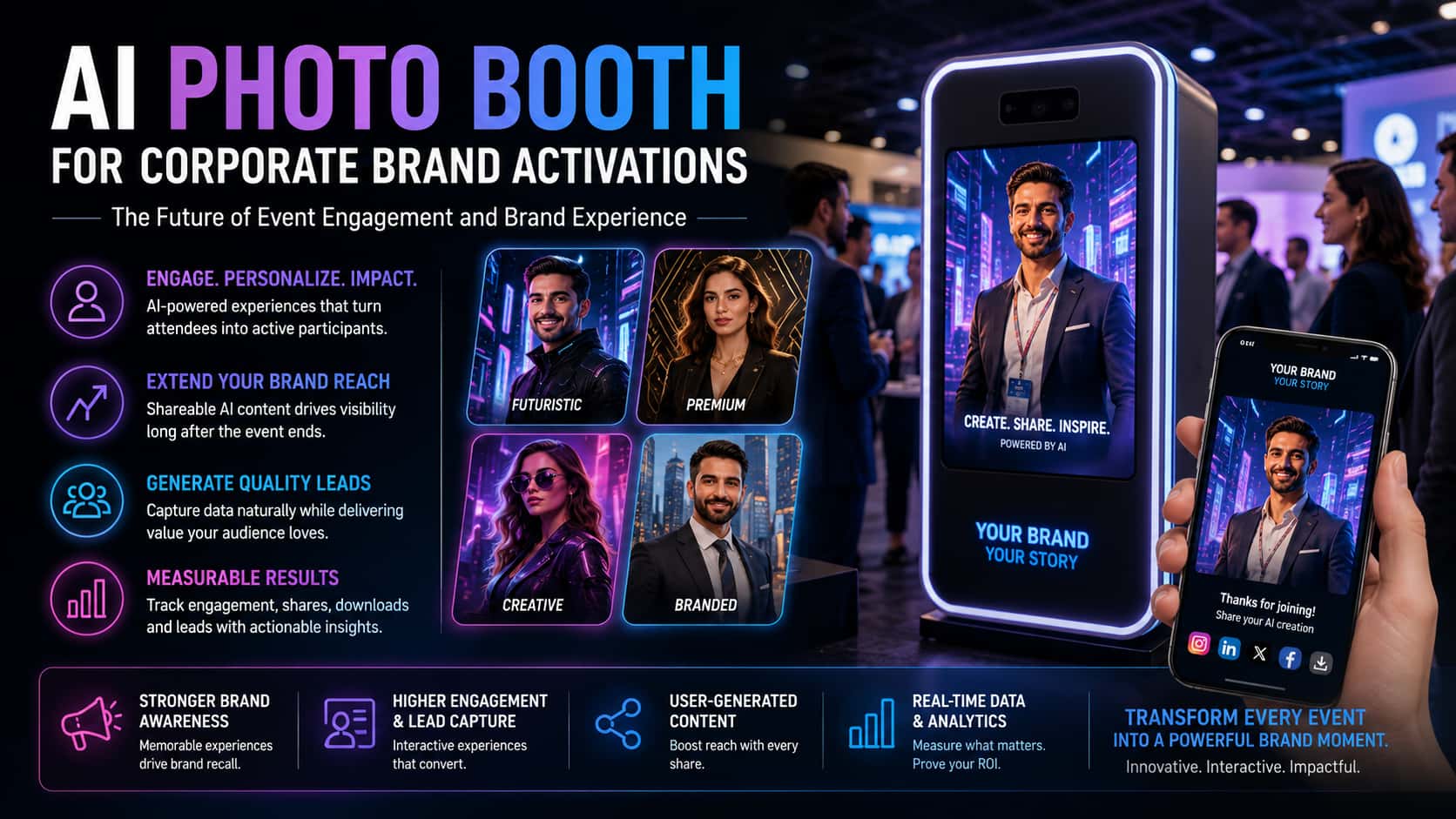
An AI avatar generator photo booth is a live event system that captures a guest photo and uses generative AI to transform that image into a stylized portrait or themed visual experience. Depending on the setup, the output may resemble a cinematic poster, gaming character, fantasy hero, executive headshot, anime portrait, action figure, trading card, or luxury fashion campaign.
The technology behind these systems has evolved rapidly. Earlier “AI booths” mostly relied on face swap filters or AI-enhanced green screen effects. Modern systems use generative image models capable of rebuilding backgrounds, outfits, lighting, textures, and entire visual environments while preserving facial likeness.
The guest workflow usually starts with a selfie or camera capture. The system then processes the image through an AI model trained for event-specific prompts and visual styles. After moderation and rendering, the final portrait is delivered through SMS, email, QR code, live gallery access, or printing stations.
One operational detail many competitors ignore is prompt engineering. Prompt quality directly affects output quality. Generic prompts create generic results. High-performing event activations use carefully structured prompts designed around brand identity, lighting consistency, facial preservation, wardrobe styling, and visual storytelling.
This is one of the biggest hidden differences between premium AI booth providers and low-cost vendors.
The Different Types of AI Avatar Booths for Events
AI avatar booths are no longer a single category. Different event objectives require completely different AI experiences.
Corporate conferences increasingly use AI headshot booths because attendees value professional content they can reuse on LinkedIn, speaker profiles, company pages, and networking platforms. These activations often perform exceptionally well because guests perceive immediate personal value from the experience.
Entertainment-focused events lean toward cinematic transformations. Guests become movie heroes, futuristic warriors, sports legends, or fantasy characters. These styles work particularly well at brand launches, gaming events, comic conventions, nightlife activations, and youth-focused campaigns because the output feels dramatic and highly shareable.
AI face swap booths remain popular for weddings and social events because they create humorous, low-pressure participation. Guests interact casually with the system, which keeps engagement high across different age groups.
Another fast-growing category involves AI trading cards and action figure concepts. Sports events, automotive brands, fitness companies, and collectibles campaigns use these experiences because they merge nostalgia, personalization, and social media appeal into one format.
Luxury retail and fashion events are moving toward virtual styling and AI-powered try-on experiences. These systems allow attendees to see themselves in branded outfits, themed campaigns, or aspirational visual environments without requiring physical wardrobe changes.
The important strategic point is this: the “best” AI booth is not universal. The right system depends entirely on event psychology, audience expectations, and business goals.
How AI Avatar Booths Improve Guest Engagement and Event ROI
Most event entertainment creates temporary attention. AI avatar experiences create active participation.
That difference changes attendee behavior immediately. Instead of casually walking past a booth, guests stop, interact, pose, review outputs, compare styles, and share results with others nearby. This naturally increases booth dwell time and social visibility.
Brands often underestimate how powerful identity-based marketing can be. When attendees become the content itself, engagement rates increase dramatically. Guests voluntarily distribute branded visuals across their own social networks because the content feels personalized rather than promotional.
This is where AI booths outperform many traditional experiential campaigns. A sponsored AI portrait shared by a guest often receives stronger engagement than a paid branded ad because it blends personal identity with entertainment.
Lead generation also improves when AI delivery systems are integrated correctly. Smart event operators use email capture, SMS access, QR delivery pages, microsites, and CRM integrations to convert entertainment into measurable marketing data.
The strongest activations measure far more than photo counts. Serious event teams monitor participation rates, share rates, opt-in conversions, branded download numbers, repeat visits, social mentions, and post-event engagement patterns.
One advanced strategy gaining momentum involves post-event retargeting. Guests who opt in can later receive additional AI-generated content variations, branded campaigns, exclusive downloads, or follow-up offers linked to their original avatar experience.
Most competitors barely discuss this lifecycle extension opportunity, even though it can significantly increase event ROI.
Choosing the Right AI Avatar Booth for Your Event
The biggest mistake event planners make is choosing AI experiences based on novelty instead of operational fit.
A booth that works beautifully at a luxury product launch may fail completely at a high-volume trade show. The audience psychology is different. The traffic patterns are different. The timing expectations are different.
Trade shows usually require faster generation times and stronger lead capture workflows because booth traffic is continuous. Guests expect quick interactions. Long rendering queues reduce conversion rates and discourage participation.
Luxury launches and VIP events operate differently. Guests are more willing to spend time creating premium portraits if the output quality feels exclusive and highly polished.
Queue management becomes one of the most important operational factors. Many providers advertise beautiful AI visuals but fail to discuss throughput. Event planners should always ask how many guests can realistically be processed per hour under live conditions.
Internet dependency also matters more than most people realize. Cloud-based AI systems can fail under unstable venue connectivity. Strong providers use local caching, backup processing systems, and redundancy planning to avoid operational breakdowns during peak traffic.
Brand customization is another major differentiator. Some providers only offer generic overlays and templates. Premium systems support custom prompt engineering, branded character styles, sponsor integration, visual consistency controls, and fully white-labeled delivery experiences.
Event planners should also ask detailed moderation questions before booking. AI systems occasionally generate inaccurate hands, distorted accessories, inconsistent logos, or strange visual artifacts. Reliable vendors actively moderate outputs instead of blindly automating everything.
That human quality-control layer often determines whether an activation feels premium or amateur.
AI Avatar Booth Pricing Explained in 2026
AI avatar booth pricing varies widely because the technology stack and operational complexity vary widely.
Basic AI selfie stations may cost relatively little because they rely on lightweight templates and automated workflows. Enterprise-level activations cost significantly more because they involve advanced AI models, live moderation teams, premium branding, custom workflows, CRM integrations, high-end hardware, staffing, and real-time support.
Customization level is usually the biggest pricing variable. Generic templates are inexpensive. Fully branded cinematic experiences require prompt engineering, visual testing, AI training refinement, and style calibration before the event even begins.
Printing capabilities also affect pricing. Digital-only activations are simpler operationally. Live printing introduces additional hardware, staffing, maintenance, and throughput considerations.
One important reality rarely discussed publicly is that cheap AI booths often create disappointing guest experiences. Slow rendering, poor likeness preservation, inconsistent outputs, weak moderation, and unreliable connectivity can damage brand perception very quickly during live events.
Premium systems usually justify their cost because they create smoother operations, stronger outputs, and better marketing performance.
The goal should never be finding the cheapest AI booth. The goal should be finding the most reliable experience for the audience size, event format, and brand expectations involved.
AI Avatar Booth Comparison Guide
| Booth Type | Best Use Case | Generation Speed | Branding Flexibility | Lead Capture Potential | Printing Support | Guest Throughput | Typical Experience Style |
|---|---|---|---|---|---|---|---|
| AI Headshot Booth | Conferences & Networking | Fast | High | Very Strong | Optional | High | Professional |
| Cinematic AI Avatar Booth | Brand Activations | Medium | Very High | Strong | Yes | Medium | Immersive |
| AI Face Swap Booth | Weddings & Parties | Fast | Moderate | Moderate | Optional | High | Social & Fun |
| AI Trading Card Booth | Sports & Gaming Events | Medium | High | Strong | Yes | Medium | Collectible |
| AI Fashion Try-On Booth | Retail & Luxury Events | Medium | Very High | Strong | Limited | Medium | Aspirational |
| AI Video Avatar Booth | Premium Launches | Slower | Very High | Strong | No | Lower | High-End Interactive |
Privacy, Consent, and AI Ethics at Live Events
Privacy has become one of the biggest decision factors for enterprise clients using AI-powered event experiences.
Guests are becoming more aware of how facial data and AI-generated content are processed. Event organizers who ignore this concern risk damaging attendee trust.
Consent should be transparent and layered properly. Attendees should understand whether images are stored temporarily or permanently, whether outputs may be used for marketing, and whether photos contribute to future AI training systems.
Enterprise-grade providers now include clear opt-in workflows, deletion request systems, retention policies, and GDPR-compliant delivery systems. These protections matter particularly at conferences, educational events, healthcare activations, and corporate gatherings.
Moderation also plays a critical role in ethical AI deployment. Unfiltered prompts can create inappropriate or off-brand outputs. Strong providers use restricted prompt frameworks, moderation layers, and human review processes to maintain quality control.
One overlooked trust factor involves communication. When guests understand exactly how their images are handled, participation rates often increase because uncertainty decreases.
Transparent privacy messaging has become a conversion tool, not just a compliance requirement.
Common Problems With AI Avatar Booths and How to Avoid Them
Most AI booth failures happen because organizers underestimate operational complexity.
Rendering speed becomes a serious issue at large events. Beautiful AI outputs lose value quickly if guests wait several minutes during peak traffic. High-capacity activations need optimized workflows, multiple capture stations, and realistic throughput planning.
Lighting quality also affects results more than many vendors admit. Poor selfies create weak AI outputs because generative systems rely heavily on the source image structure. Controlled lighting environments dramatically improve consistency.
Over-stylization is another common problem. Some AI systems distort facial identity so aggressively that guests no longer recognize themselves naturally. Strong providers balance creativity with likeness preservation.
Connectivity issues remain a major operational risk. Venue Wi-Fi often struggles under heavy attendee traffic. Reliable vendors prepare offline workflows, local processing support, and redundancy systems before the event begins.
Booth placement can quietly ruin activations as well. AI booths placed near loud entrances, dark corners, or congested pathways typically underperform because guests feel rushed or distracted during capture.
The best activations treat AI booths like experiential productions rather than simple photography stations.
The Future of AI Avatar Generator Booths
Static AI portraits are only the beginning.
Real-time AI video generation is becoming increasingly viable for premium events. Guests will soon interact with animated versions of themselves rather than still images alone. Motion capture, live cinematic rendering, and AI-generated storytelling experiences are already entering high-budget experiential campaigns.
Personalization will also become deeper. Future systems will adapt visual styles dynamically based on guest preferences, event themes, sponsor relationships, and behavioral data.
Digital identity integration is another major direction. AI-generated event avatars may eventually connect to networking systems, virtual communities, event gamification platforms, and metaverse-style environments.
The most important long-term trend is this: AI event experiences are moving from novelty entertainment toward persistent branded identity ecosystems.
Brands that understand this shift early will build stronger audience relationships than competitors still relying on passive event marketing formats.
Are AI Avatar Generator Booths Worth It for Events?
For many event categories, the answer is yes.
AI avatar booths create stronger emotional engagement than traditional photography because guests become active participants in the experience. They also generate measurable business outcomes when integrated correctly with lead capture, social sharing, CRM systems, and branded content workflows.
The strongest results usually come from activations that balance entertainment and operational discipline. Beautiful visuals alone are not enough. Rendering speed, moderation quality, booth throughput, privacy protection, and delivery systems all affect guest perception.
A well-executed AI avatar activation feels seamless, premium, and memorable. A poorly planned one feels slow, gimmicky, and frustrating.
That difference is why strategic planning matters far more than hype.
Frequently Asked Questions
What is an AI avatar generator photo booth?
An AI avatar generator photo booth is an event experience that uses generative AI to transform guest selfies into stylized portraits, characters, or branded digital visuals.
How does an AI photo booth work at events?
Guests capture a selfie or portrait, the AI system processes the image using predefined prompts and visual styles, and the final output is delivered digitally or through printing systems.
How much does an AI avatar photo booth cost?
Pricing depends on customization, staffing, event duration, printing, branding complexity, AI model quality, and guest volume requirements.
Are AI photo booths good for corporate events?
Yes. Corporate events often use AI booths for branded headshots, networking engagement, lead generation, sponsor activations, and social media amplification.
Can AI avatar booths print photos instantly?
Many systems support instant printing, although print speed depends on rendering time, printer setup, and event throughput.
Do AI photo booths collect guest data?
Most systems can collect emails, phone numbers, opt-ins, and analytics data when integrated with lead capture workflows.
Are AI-generated event photos safe and private?
Professional providers use GDPR-compliant workflows, moderation systems, consent management, and secure image handling processes.
What is the difference between an AI photo booth and a regular photo booth?
Traditional booths capture static photos. AI booths generate stylized, personalized, and branded visual experiences using generative AI technology.
How long does it take to generate an AI avatar?
Generation times vary by system quality and complexity. Most live event activations aim for outputs within seconds to maintain queue flow.
Can AI avatar booths work without internet access?
Some advanced systems support local processing or hybrid workflows, reducing dependency on unstable venue internet connections.
Which events are best for AI avatar photo booths?
Corporate conferences, trade shows, weddings, exhibitions, product launches, gaming events, mall activations, and luxury brand campaigns all benefit from AI-powered experiences.
Are AI avatar booths worth it for trade shows and exhibitions?
Yes. They increase booth engagement, attract foot traffic, generate social sharing, and improve lead capture opportunities when executed properly.