
AI photo booths have transformed event photography from a simple image-capturing activity into an intelligent, interactive experience. What once required photographers, graphic designers, editors, and production teams can now happen automatically within seconds through a combination of computer vision, machine learning, generative AI, and advanced image processing systems.
Many people assume AI photo booths are simply traditional photo booths with filters. The reality is far more sophisticated. Modern AI photo booths use multiple technologies working together simultaneously to analyze faces, understand scenes, generate new visual elements, enhance image quality, personalize experiences, and deliver professional results instantly.
As organizations increasingly prioritize memorable event experiences, AI-powered activations have become a central part of corporate events, exhibitions, product launches, luxury celebrations, and experiential marketing campaigns. Industry leaders such as Emirates Snap Booth have helped redefine expectations by combining premium event production with cutting-edge AI technologies that create highly personalized guest experiences.
Understanding how these systems actually work provides valuable insight into why AI photo booths have become one of the most powerful engagement tools in modern events.
What Is an AI Photo Booth?
An AI photo booth is an intelligent photography system that combines professional imaging hardware with artificial intelligence software to create customized photographs, avatars, branded visuals, and immersive digital experiences.
Unlike traditional booths that simply capture and print photographs, AI-powered systems actively analyze the subject and modify images using advanced algorithms. The system can recognize faces, separate people from backgrounds, apply artistic styles, generate entirely new scenes, enhance image quality, and distribute results instantly.
The shift from traditional photography to AI-powered experiences reflects a broader change in how people interact with content. Guests no longer want static souvenirs. They want personalized experiences that feel unique to them and share naturally across social platforms.
The Evolution from Traditional Photo Booths to AI-Powered Experiences
Traditional photo booths were designed around a simple workflow. A guest entered the booth, captured several photographs, and received printed images.
Digital booths expanded this concept by introducing social sharing and digital delivery. AI photo booths represent the next evolution by adding intelligence into every stage of the process.
Instead of simply recording what the camera sees, AI systems interpret the scene. They understand who is present, identify visual characteristics, recognize themes, and generate entirely new outputs based on predefined creative goals.
This shift has transformed photo booths from photography devices into experience platforms.
What Makes an AI Photo Booth Different?
The defining feature of an AI photo booth is its ability to make decisions and generate content automatically.
Traditional booths rely entirely on the camera’s captured image. AI-powered systems use computer vision and machine learning to understand the image first, then improve or transform it.
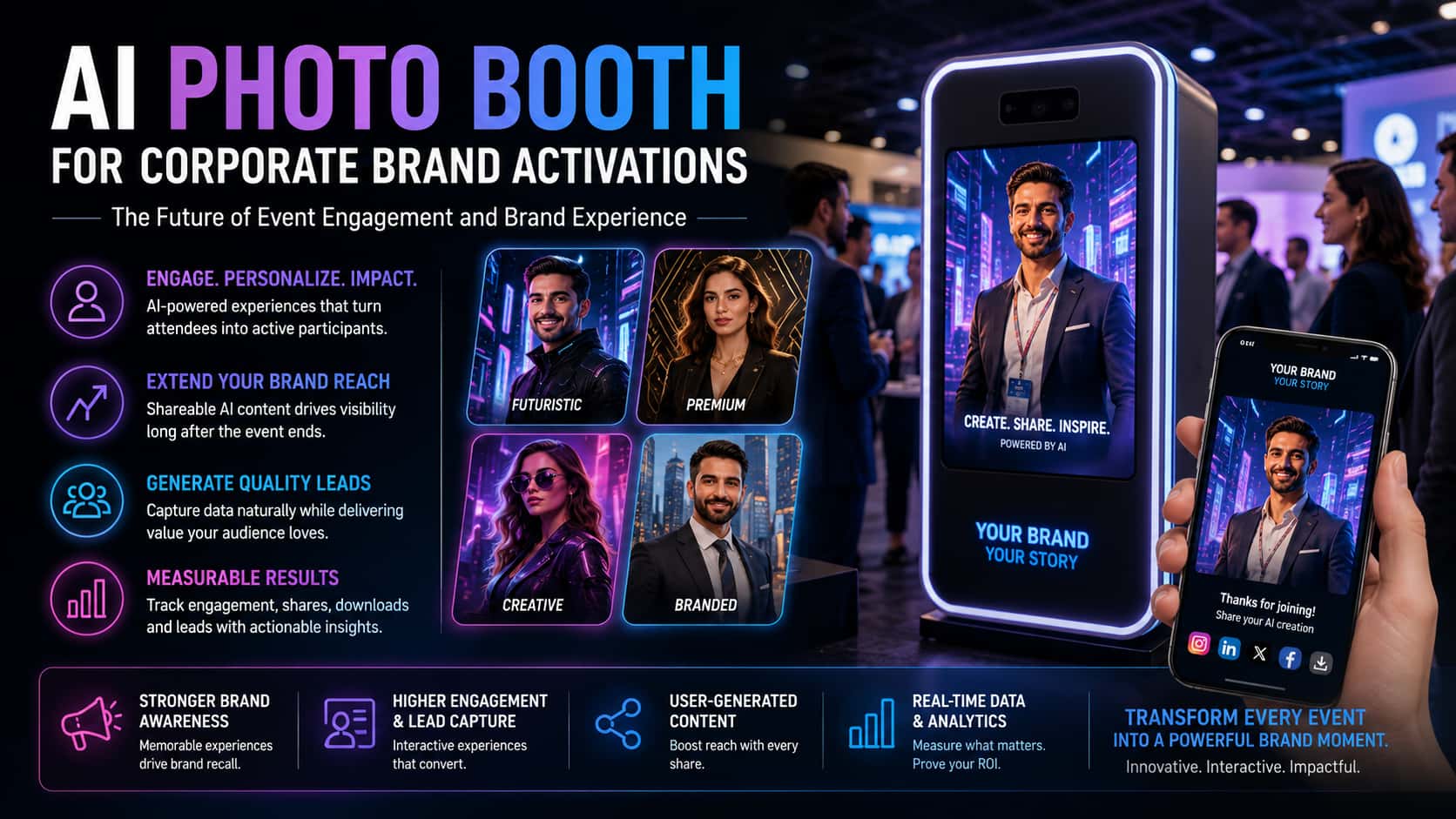
For example, an AI photo booth can place a guest into a futuristic cityscape, create a luxury magazine-style portrait, transform participants into cinematic characters, or generate branded visual assets that align perfectly with an event theme.
Companies like Emirates Snap Booth have demonstrated how these capabilities can elevate events from simple entertainment into immersive brand experiences that generate lasting engagement.
Why AI Photo Booths Have Become a Major Event Technology Trend
The growth of AI photo booths is driven by personalization.
Modern audiences expect experiences tailored specifically to them. Generic event photography no longer creates the same excitement or social sharing behavior.
AI-generated content feels unique because every output is customized. Guests receive visuals that cannot be replicated elsewhere, making them significantly more likely to engage, share, and remember the experience.
For event organizers, this creates a powerful combination of entertainment, brand visibility, and audience participation.
How AI Photo Booths Work: The Complete Technology Pipeline
Behind every AI-generated image is a complex chain of technologies operating within seconds.
Understanding this pipeline reveals why high-quality AI photo booth experiences require far more than a camera and software.
Step 1: Image Capture and Camera Hardware
Everything begins with image acquisition.
Professional AI photo booths use high-quality camera systems designed to capture detailed facial information, accurate colors, and sharp imagery under varying lighting conditions.
The quality of the final output is heavily influenced by the quality of the original image. Even the most advanced AI models depend on strong source material.
Premium providers such as Emirates Snap Booth prioritize professional-grade hardware because superior image data creates superior AI-generated results.
Lighting systems also play a critical role. Balanced illumination helps AI algorithms accurately detect facial features, skin tones, and image boundaries.
Step 2: Computer Vision Detects and Analyzes the Subject
Once an image is captured, computer vision systems begin analyzing it.
Computer vision functions as the eyes of the AI system. It identifies faces, determines facial positions, measures landmarks, and understands the composition of the scene.
The software examines dozens of facial reference points to establish identity and orientation. It determines where eyes, noses, mouths, jawlines, and other features are positioned.
This analysis enables later stages of processing to maintain realistic proportions and recognizable identities.
Without this step, generated results would appear inconsistent or distorted.
Step 3: AI Segmentation Separates the Person from the Background
One of the most impressive capabilities of modern AI photo booths is background separation.
Historically, this process required green screens and extensive editing. Today’s systems use semantic segmentation to isolate subjects automatically.
Semantic segmentation allows the AI to distinguish people from surrounding objects with remarkable accuracy.
Hair strands, clothing edges, accessories, and intricate details can be separated from the original environment without requiring specialized backgrounds.
This capability allows AI photo booths to place guests into entirely new environments while preserving realism.
Step 4: Generative AI Creates New Visual Content
After segmentation, generative AI becomes the primary creative engine.
Generative models analyze the subject and produce new visual elements based on predefined instructions, prompts, or themes.
This is where the technology moves beyond enhancement and enters content creation.
The AI may generate luxury environments, futuristic settings, artistic interpretations, branded scenes, cinematic portraits, fantasy landscapes, or highly customized visual experiences.
Advanced systems preserve facial identity while generating surrounding elements that align with the desired theme.
This balance between realism and creativity separates premium AI experiences from low-quality implementations.
Step 5: Compositing and Brand Layer Integration
Once AI-generated elements are created, compositing technology combines everything into a final image.
Compositing involves merging multiple visual layers into a cohesive scene. The subject, generated background, branding assets, overlays, and graphical elements must appear naturally integrated.
This stage is particularly important for corporate activations.
Organizations frequently require logos, campaign visuals, event themes, and brand messaging to appear within generated images. Sophisticated compositing ensures these assets feel intentional rather than artificially placed.
This is one area where experienced providers such as Emirates Snap Booth create significant differentiation. Effective compositing transforms AI-generated imagery into polished marketing assets rather than novelty photos.
Step 6: Delivery and Distribution Systems
The final stage focuses on distribution.
Once processing is complete, guests receive their content through digital delivery systems designed for speed and convenience.
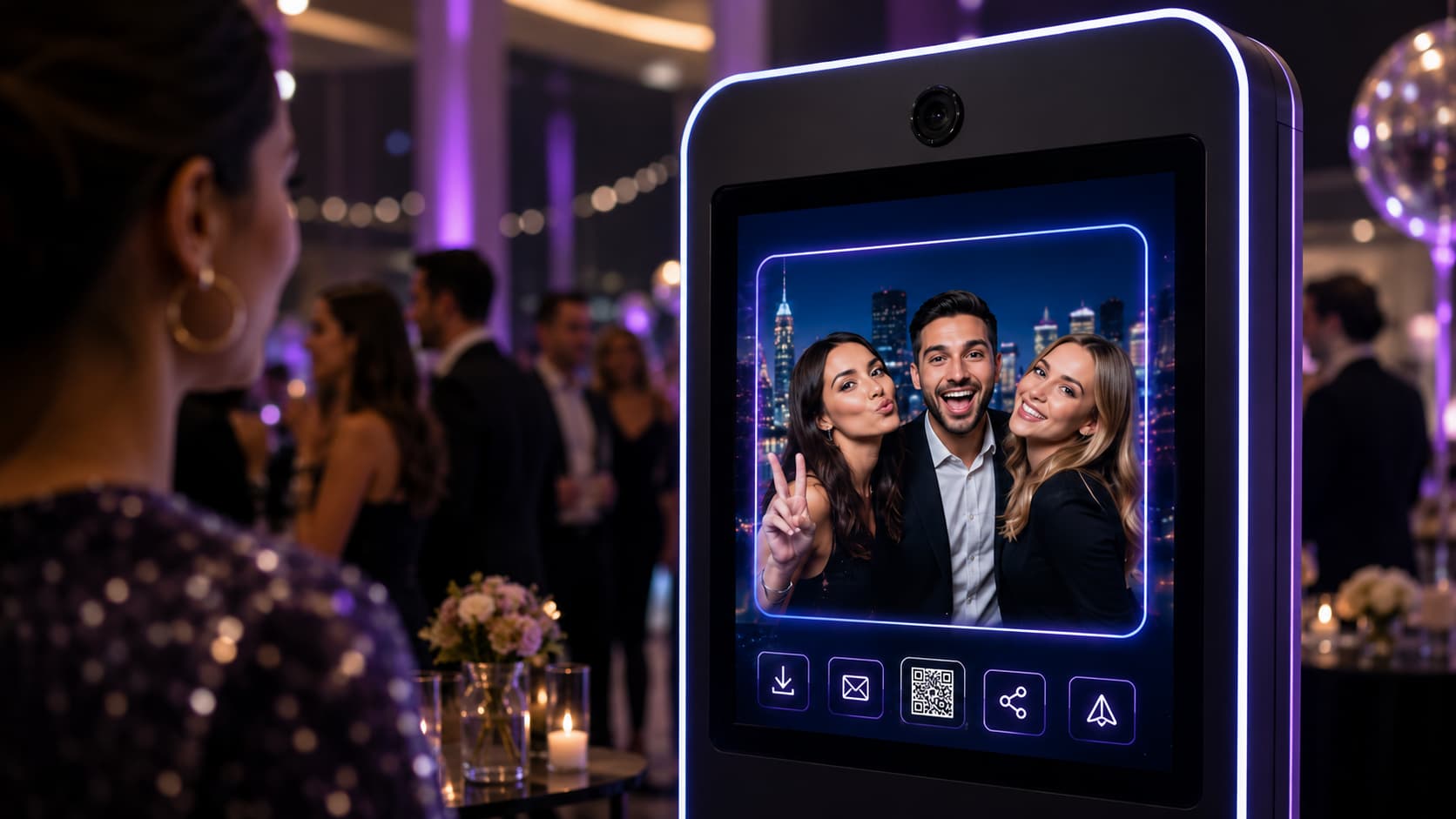
Modern platforms support instant downloads, QR-based access, email delivery, social sharing integrations, and live event galleries.
The user experience at this stage often determines overall satisfaction.
A technically impressive image loses impact if delivery is slow or complicated. High-performing AI photo booth systems therefore place equal emphasis on generation speed and distribution efficiency.
The Core Technologies Powering Modern AI Photo Booths
Many articles simplify AI photo booths as a single technology. In reality, they represent an ecosystem of interconnected systems.
Understanding these underlying technologies provides insight into why results vary dramatically between providers.
Computer Vision and Facial Mapping
Computer vision enables machines to interpret visual information.
In AI photo booths, facial mapping technology identifies unique facial structures and spatial relationships between features.
This mapping process helps preserve identity across transformations. Whether a guest becomes a futuristic character or appears within a branded campaign scene, the system must maintain recognizable facial characteristics.
The strongest AI experiences prioritize identity preservation because users connect more deeply with outputs that still look authentically like themselves.
Machine Learning Models and Neural Networks
Machine learning models serve as the decision-making framework behind AI photo booth systems.
These models are trained to recognize patterns across massive image datasets. Through training, they learn how faces appear under different lighting conditions, how human features relate to one another, and how realistic imagery should look.
Neural networks process this information through multiple layers of analysis, enabling increasingly sophisticated image generation and enhancement.
As training improves, outputs become more realistic, accurate, and visually compelling.
Diffusion Models and Generative AI Systems
The recent surge in AI photo booth popularity is closely tied to advancements in diffusion models.
Diffusion-based systems produce highly detailed imagery by gradually constructing visual content through iterative refinement.
This process allows AI to generate realistic textures, lighting effects, backgrounds, clothing variations, and artistic styles that were previously difficult to achieve.
The quality leap created by diffusion models has fundamentally changed what event organizers can expect from AI-generated experiences.
Image Enhancement and Quality Optimization
Before final delivery, images often pass through additional optimization layers.
These systems perform upscaling, denoising, lighting correction, color balancing, and detail refinement.
A professional AI workflow does not stop when generation is complete. It continues improving the image until it reaches production-ready quality.
This final optimization stage is one reason premium providers consistently produce stronger results than platforms that rely solely on basic generation tools.
The Difference Between AI Face Swap, AI Avatars, AI Background Replacement and AI Photo Booths
Although these technologies are often grouped together, they serve different purposes and rely on different levels of AI sophistication.
| Technology | Primary Function | AI Technology Used | Processing Complexity | Typical Event Use |
|---|---|---|---|---|
| AI Face Swap | Replaces one face with another while preserving expressions | Facial mapping, landmark detection, identity transfer | Moderate | Entertainment activations, themed experiences |
| AI Avatars | Creates stylized or fictional versions of a person | Generative AI, diffusion models, style transfer | High | Corporate events, brand activations, social sharing |
| AI Background Replacement | Changes the environment around a subject | Semantic segmentation, scene generation | Moderate | Weddings, exhibitions, experiential marketing |
| AI Photo Booth | Combines capture, analysis, generation, branding, and delivery into one workflow | Computer vision, machine learning, generative AI, compositing, distribution systems | Very High | Corporate events, luxury experiences, trade shows, product launches |
The key distinction is that an AI photo booth is not a single feature. It is an entire technology ecosystem. Face swaps, avatars, and background replacement are individual capabilities that can exist within a broader AI photo booth experience.
Many organizations mistakenly compare AI photo booths with standalone AI image tools. The better comparison is between a complete event engagement platform and a single software feature.
The most successful deployments integrate multiple technologies into a seamless guest journey. This is why providers such as Emirates Snap Booth focus on the entire experience rather than isolated AI effects.
Cloud AI vs Local AI Processing: How Event Photo Booths Handle Images
One of the least discussed aspects of AI photo booth technology is where processing actually occurs.
The answer has a direct impact on speed, reliability, privacy, and image quality.
Local GPU Processing
Local processing takes place directly on powerful computers located at the event venue.
This approach offers excellent response times because images do not need to travel across the internet. It also reduces dependency on network availability and can improve privacy for sensitive corporate events.
Organizations operating in highly controlled environments often prefer local processing because it minimizes data transfer outside the venue.
Cloud-Based Processing
Cloud processing sends images to remote servers where advanced AI models perform generation and enhancement tasks.
Cloud systems provide access to powerful infrastructure and sophisticated AI models that may exceed the capabilities of on-site hardware.
This approach allows providers to scale resources dynamically and deploy increasingly advanced AI technologies without changing physical equipment.
Hybrid Systems Used by Premium Providers
The strongest event experiences increasingly rely on hybrid architectures.
In a hybrid model, certain tasks occur locally while more advanced generation functions are handled through cloud infrastructure.
This approach combines speed, reliability, scalability, and image quality.
Many premium event technology providers, including Emirates Snap Booth, favor hybrid workflows because they offer the best balance between performance and flexibility.
Which Approach Produces Better Results?
There is no universal winner.
The best solution depends on event objectives, privacy requirements, internet availability, processing complexity, and guest volume.
Organizations focused solely on image quality often benefit from cloud-enhanced workflows. Events prioritizing privacy and operational control may prefer local processing.
The strongest deployments are designed around event-specific requirements rather than rigid technology preferences.
What Determines the Quality of an AI Photo Booth Experience?
The quality of an AI photo booth experience depends on far more than the AI model itself.
Camera Quality and Lighting Conditions
Every AI workflow begins with image capture.
Poor lighting creates inaccurate facial detection, weaker segmentation, and less realistic generation results.
Professional-grade lighting and imaging systems dramatically improve final outputs because they provide cleaner data for AI models to process.
Accuracy of Facial Recognition and Segmentation
Identity preservation remains one of the most important quality indicators.
Guests want transformed images that still look like them.
Strong facial recognition systems maintain recognizable characteristics while allowing creative modifications to occur around the subject.
Speed of AI Processing
Guests expect near-instant results.
Even highly impressive visuals lose impact if generation times interrupt event flow.
The most effective systems balance quality with responsiveness, creating outputs quickly without sacrificing realism.
Event-Specific Customization
Generic AI experiences rarely produce memorable results.
The strongest activations are customized around brand identity, event objectives, audience demographics, and visual themes.
This strategic customization is where providers such as Emirates Snap Booth create substantial value for corporate clients and luxury events.
User Experience Design and Guest Flow
Technology alone does not create successful experiences.
Guest onboarding, interface design, content selection, delivery methods, and queue management all influence perceived quality.
The best AI photo booth experiences feel effortless from start to finish.
Common Challenges AI Photo Booth Technology Must Solve
While AI photo booth technology has advanced significantly, it still faces practical challenges.
Group Photos and Multiple Faces
Single-subject images are relatively straightforward.
Large groups introduce complexity because the system must accurately identify multiple faces, maintain consistent proportions, and preserve individual identities simultaneously.
Glasses, Hats and Accessories
Accessories can obscure facial features and complicate segmentation.
Advanced models must determine which elements belong to the face and which should remain separate during generation.
Low-Light Event Environments
Luxury events, gala dinners, and evening activations often present difficult lighting conditions.
AI systems must compensate for shadows, color shifts, and reduced image detail while maintaining accuracy.
Motion Blur and Fast Movement
Guests rarely remain perfectly still.
Movement can introduce blur that reduces the quality of facial mapping and image generation.
Professional event workflows address this challenge through optimized capture settings and intelligent enhancement systems.
Maintaining Realistic Facial Identity
One of the most difficult challenges in generative AI is preserving identity while transforming appearance.
Successful AI photo booths strike a careful balance between creativity and realism.
Preventing AI Artifacts and Distortions
Hands, accessories, background elements, and complex textures can sometimes create visual inconsistencies.
Advanced quality-control systems help identify and correct these issues before images reach guests.
A practical insight often overlooked by competitors is that the best AI photo booth experiences are not defined by the creativity of the generated scene. They are defined by how effectively the technology avoids visible mistakes.
AI Photo Booth Privacy, Security and Data Protection
As AI technology becomes more sophisticated, privacy considerations become increasingly important.
How Guest Photos Are Processed
Most AI photo booth systems analyze images temporarily during processing.
The image is examined, transformed, enhanced, and delivered before storage policies are applied.
Organizations should always understand how providers handle image data throughout this process.
Understanding Biometric and Facial Data
Many AI systems use facial analysis to identify landmarks and positioning.
This process helps generate realistic outputs but raises legitimate questions about data usage.
Responsible providers maintain transparency regarding how images are processed and managed.
Image Storage Policies
Storage policies vary significantly between providers.
Some systems retain images temporarily, while others allow clients to determine retention requirements.
Corporate clients often require specific handling procedures to align with internal compliance standards.
Event Compliance and User Consent
Guest awareness is an important component of ethical AI deployment.
Clear communication regarding image usage, sharing permissions, and retention policies helps build trust and confidence.
Best Practices for Corporate Events
Corporate activations frequently involve brand-sensitive environments.
Leading providers such as Emirates Snap Booth prioritize secure workflows, transparent processing practices, and responsible deployment strategies that support client compliance objectives.
Why Brands and Event Organizers Are Investing in AI Photo Booths
Organizations increasingly view AI photo booths as strategic engagement tools rather than event entertainment.
Corporate Event Engagement
AI experiences encourage participation because they create highly personalized outcomes.
Guests become active participants rather than passive attendees.
Trade Show Lead Generation
Interactive experiences attract attention and increase booth engagement.
AI-generated content also creates opportunities for ongoing brand interaction after the event concludes.
Experiential Marketing Campaigns
Modern marketing focuses on creating memorable experiences.
AI photo booths allow brands to connect digital engagement with physical event environments.
Social Sharing and Organic Reach
Personalized content is naturally shareable.
When guests receive unique, visually impressive outputs, they are more likely to distribute them across social platforms.
Data Collection and Marketing Attribution
When implemented responsibly, AI activations can support broader marketing objectives through engagement tracking, content sharing analysis, and campaign performance measurement.
How Emirates Snap Booth Sets the Benchmark for AI Photo Booth Innovation
The difference between a standard AI photo booth and a premium activation often comes down to execution.
Combining Premium Event Production with Advanced AI Technology
Emirates Snap Booth approaches AI photo booth experiences as complete event solutions rather than isolated technology deployments.
This perspective allows every element of the guest journey to work together cohesively.
Delivering Fast, High-Quality AI-Generated Experiences
Speed and quality are often treated as competing priorities.
Emirates Snap Booth focuses on optimizing both, ensuring guests receive visually impressive results without unnecessary delays.
Custom-Branded Activations for Corporate and Luxury Events
Brand integration requires more than placing a logo onto an image.
Successful activations align visual design, generated environments, content delivery, and user experience with the overall event strategy.
Privacy-Conscious AI Photo Booth Deployments
As organizations become more aware of AI governance requirements, privacy-conscious workflows become increasingly important.
Emirates Snap Booth emphasizes responsible implementation practices that align with modern business expectations.
The Future-Focused Approach Behind Emirates Snap Booth
Technology continues evolving rapidly.
Maintaining leadership requires continuous investment in emerging capabilities, operational excellence, and event innovation.
This commitment positions Emirates Snap Booth as both a solution provider and a trusted authority within the AI photo booth industry.
The Future of AI Photo Booth Technology
The next generation of AI photo booth experiences will move beyond static images.
Real-Time AI Video Generation
Future systems will generate personalized video content in real time, creating richer and more immersive experiences.
Personalized AI Characters and Digital Twins
Guests will increasingly interact with AI-generated versions of themselves that evolve across multiple event touchpoints.
Multi-Person Scene Generation
Advances in computer vision will improve the ability to generate highly complex scenes involving groups, teams, and collaborative experiences.
Voice-Controlled AI Experiences
Natural language interaction will make AI photo booth experiences more intuitive and personalized.
Fully Immersive Event Activations
The future lies in connected ecosystems where photography, video, augmented reality, AI generation, and experiential marketing operate together seamlessly.
Final Thoughts: The Technology Behind the Magic
AI photo booths represent the convergence of multiple technological disciplines working together in real time.
Professional imaging hardware captures the initial image. Computer vision analyzes the subject. Segmentation isolates key elements. Generative AI creates new content. Compositing systems merge visual layers. Delivery platforms distribute the final result instantly.
What appears simple to guests is actually a sophisticated technology stack operating behind the scenes.
Organizations seeking meaningful engagement, memorable experiences, and premium event activations increasingly recognize the value of this technology. When executed correctly, an AI photo booth becomes far more than a photography tool. It becomes a personalized storytelling platform.
Providers such as Emirates Snap Booth continue to push the industry forward by combining advanced AI capabilities with exceptional event execution, creating experiences that are memorable, shareable, and strategically aligned with modern event objectives.
Frequently Asked Questions
How does an AI photo booth actually work?
An AI photo booth captures a photo, analyzes the subject using computer vision, applies AI-powered enhancements or generation techniques, and delivers a customized image digitally or through event distribution systems.
What technology is used in AI photo booths?
AI photo booths use computer vision, machine learning, neural networks, facial mapping, semantic segmentation, generative AI models, image compositing, and digital delivery platforms.
Do AI photo booths use facial recognition?
Most AI photo booths use facial analysis and landmark detection to identify facial features and preserve identity during image generation.
How long does an AI photo booth take to generate an image?
Generation speed depends on system architecture, image complexity, and processing methods, but modern premium systems are designed to deliver results rapidly.
Are AI photo booths safe for corporate events?
Yes. Reputable providers implement privacy-conscious workflows, secure processing methods, and transparent data handling procedures suitable for corporate environments.
Can AI photo booths work without internet access?
Some systems support local processing and offline operation, while others rely partially or entirely on cloud infrastructure.
What is the difference between an AI photo booth and a traditional photo booth?
Traditional photo booths capture and print images. AI photo booths analyze, enhance, transform, personalize, and distribute content using advanced artificial intelligence technologies.
How accurate are AI-generated event photos?
Accuracy depends on image quality, lighting conditions, facial mapping capabilities, and the sophistication of the AI models being used.
Can AI photo booths create custom branded images?
Yes. Modern AI photo booths can incorporate brand elements, event themes, visual identities, and customized creative concepts into generated content.
Are guest photos stored after an event?
Storage policies vary by provider. Professional providers offer transparent data management practices and retention options aligned with client requirements.
What equipment is required for an AI photo booth?
Most systems include professional cameras, lighting equipment, touchscreen interfaces, processing hardware, AI software, and digital delivery platforms.
What is the future of AI photo booth technology?
The future includes real-time video generation, personalized digital twins, voice-driven interactions, enhanced personalization, and increasingly immersive event experiences.